1. Quantum Wires
Introduction
This study aims to calculate the light absorption spectrum of aluminum-gallium arsenide (AlxGa1-xAs) quantum wires fabricated in laboratory conditions.
The heterostructures are obtained through controlled aluminum composition variation during growth. Electron microscopy reveals Al-rich bulges that form the quantum confinement.
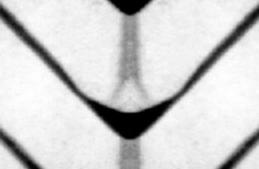
Microscopie électronique d'un fil quantique AlGaAs
Absorption calculation requires preliminary determination of electronic states and hole states, which localize in lowest potential regions. These states enable optical transitions with photon emission or absorption.
Negative absorption indicates light amplification, a property exploited in laser gain media.
Electronic States Calculation
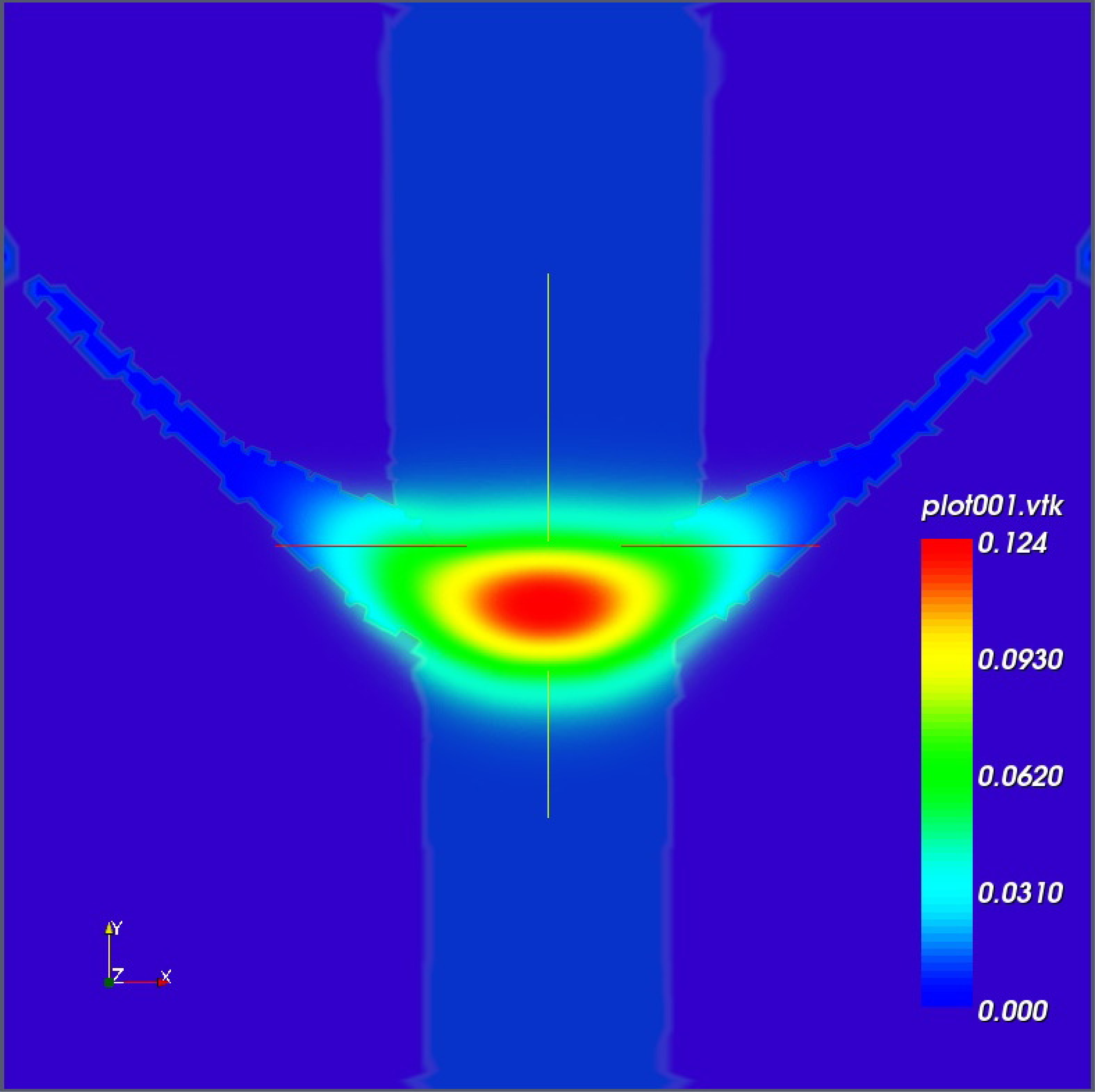
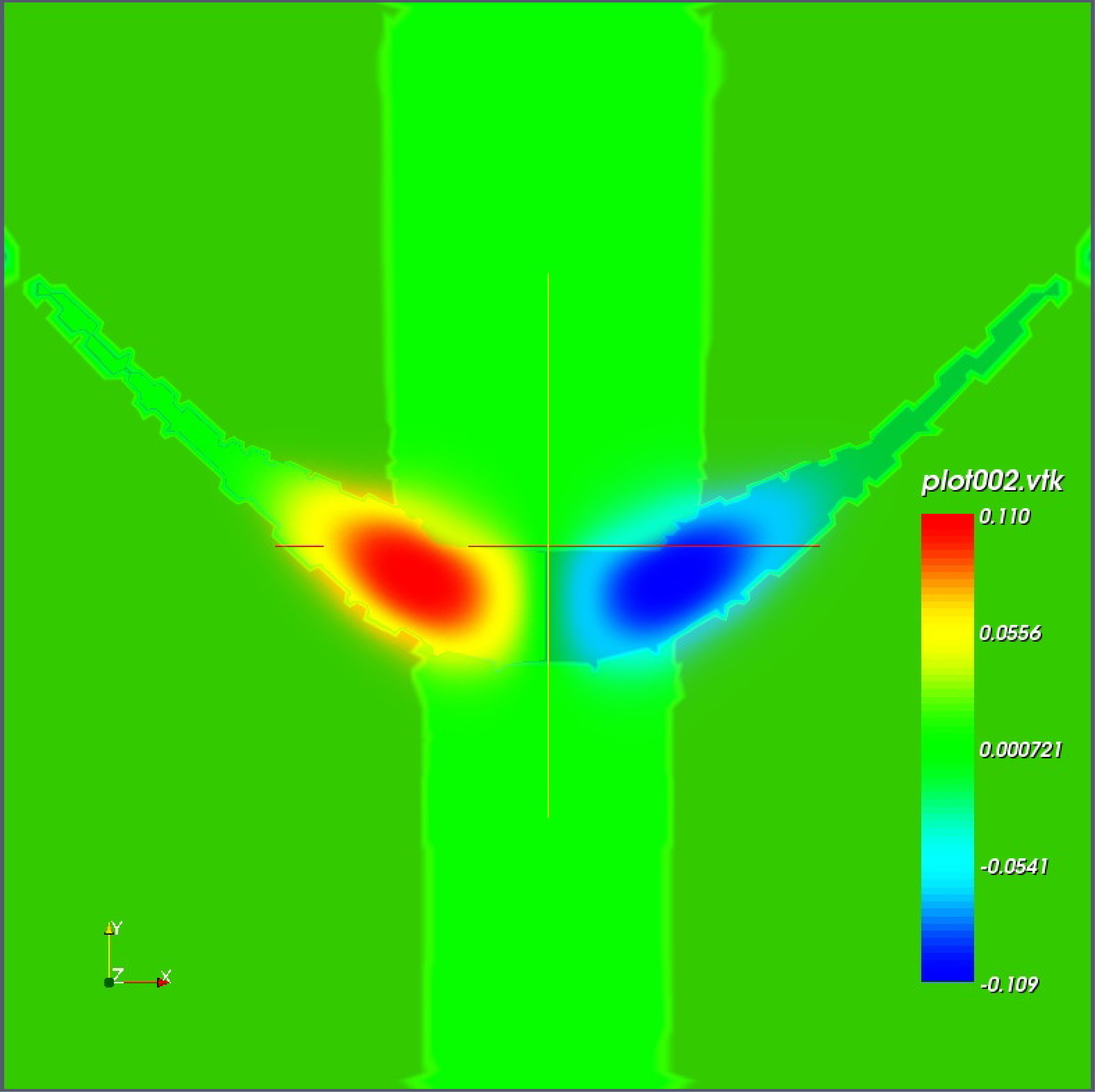
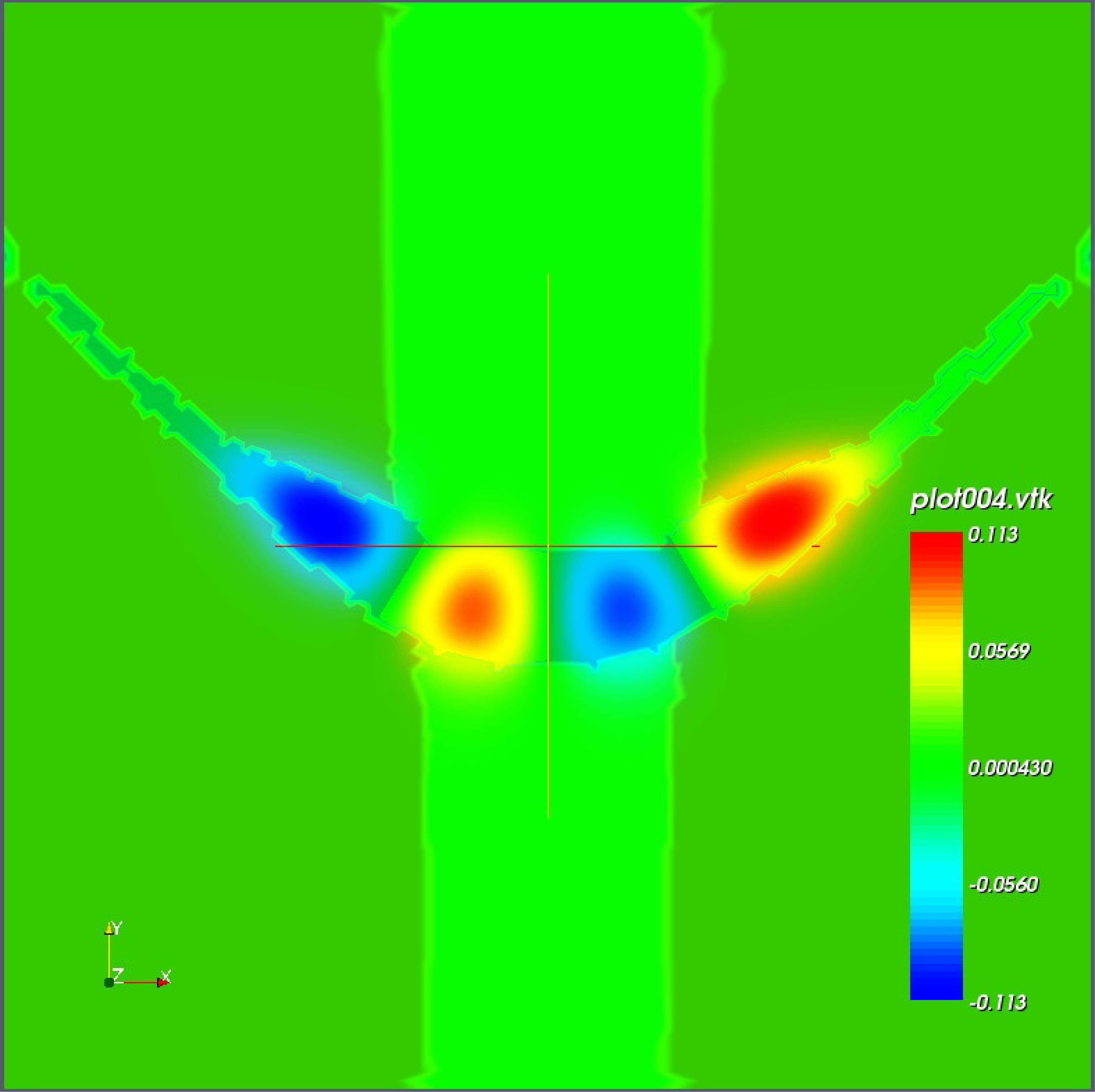
Schrödinger equation resolution for this complex geometry is performed by variable separation: periodic part along the wire, transverse part solved by finite elements after meshing.
État fondamental
1er état excité

2ème état excité
3ème état excité
Probability densities of the first 4 electronic states
The states show characteristic localization in the confinement region, with discrete energies typical of confined quantum systems.
Hole States Treatment
Unlike electrons, holes in semiconductors require complete spinorial treatment. The Luttinger-Kohn Hamiltonian, accounting for valence band mixing (j=3/2), replaces the simple effective mass approximation.

Sans mélange de bandes de valence
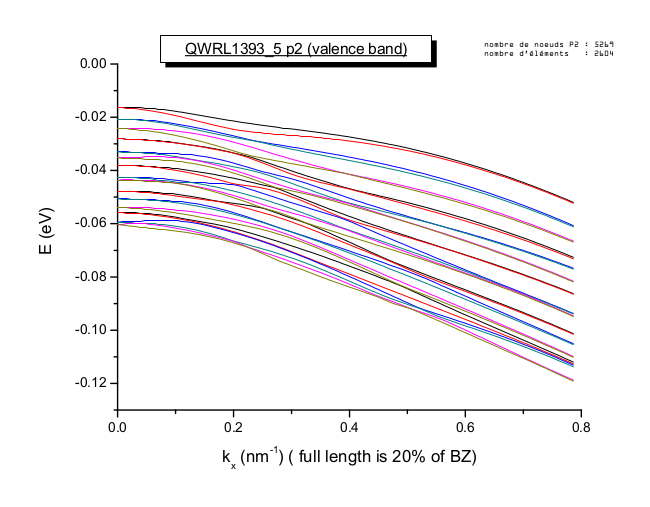
Avec mélange de bandes de valence
Energy dispersion comparison with and without band mixing
Band mixing lifts degeneracies and significantly modifies the hole band structure, with important implications for optical transitions.
Absorption Spectra Calculation
Transition amplitudes are calculated from electron and hole wavefunctions, including light polarization effects and statistical level populations.
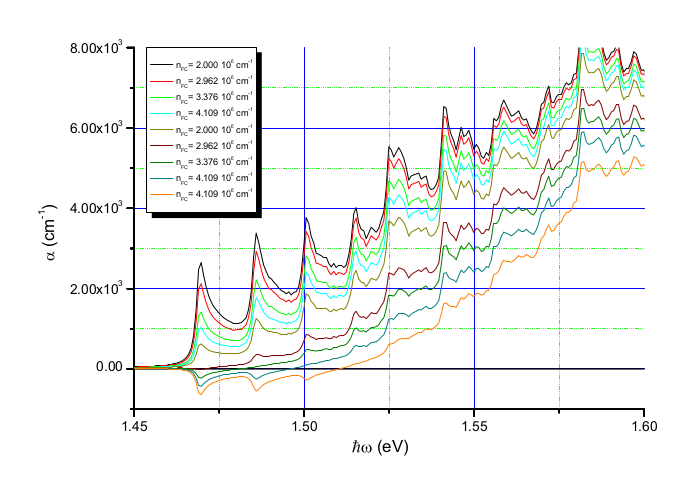
Résolution grossière
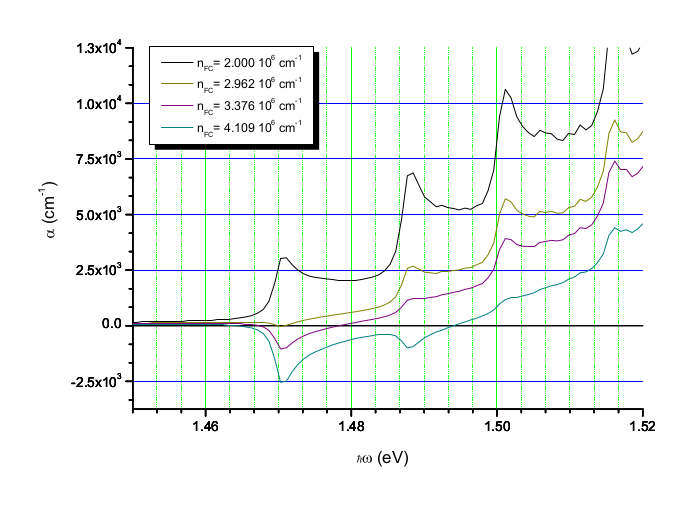
Résolution fine
Absorption spectra for different calculation resolutions
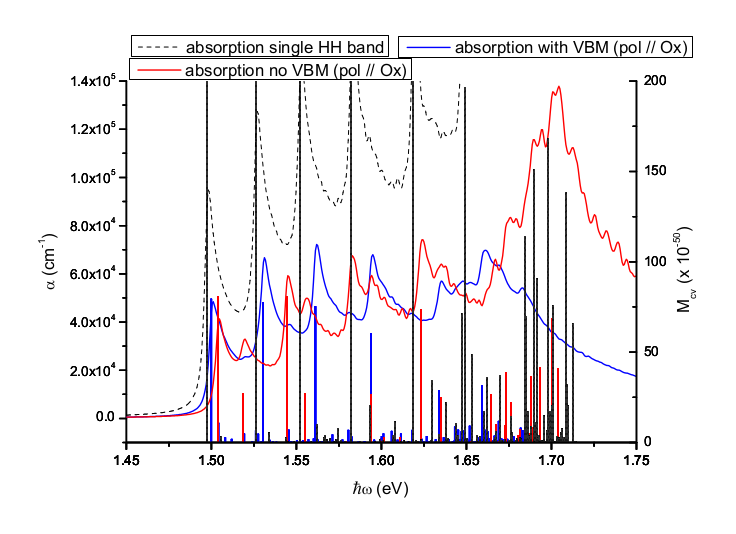
Comparaison des spectres d'absorption pour différentes polarisations
Technical Note
Calculations include: proper envelope function treatment, electric dipole light-matter coupling, and Fermi-Dirac distribution for populations.
2. Quantum Dots
Quantum dots, or nanocrystals, are semiconductor nanostructures providing three-dimensional carrier confinement.
Spherical Theoretical Model
For this study, we developed a theoretical model of spherical quantum dots with parameters:
- Confinement potentials for electrons and holes
- Effective dot radius
- Material parameters (effective masses, dielectric constants)
- Quantum size effects
Many-Particle States
The originality of this study lies in systematic exploration of correlated N-body states:
Excitons (X)
Bound electron-hole states
eh
Trions
Two electrons + one hole or two holes + one electron
eeh / ehh
Bi-excitons (XX)
Bound two electron-hole pair states
eehh
These composite states exhibit binding energies and optical properties distinct from simple sums of individual particles.
Methodological Approach
Multiparticle Schrödinger equation resolution by configuration interaction method, with spherical Bessel basis functions.