1. Mechanical Resistance [january 2024]
Methodology
This study was conducted in R using rstan and brms packages for Bayesian inference.
Bayesian Philosophy
Unlike classical frequentist methods that provide point estimates, Bayesian analysis produces complete probability distributions for parameters of interest.
This approach offers several advantages:
- Statistical honesty : Complete uncertainty presentation
- Natural inference : Direct calculation of posterior probabilities
- Prior information integration : Incorporation of domain expertise
- Probabilistic predictions : Credibility intervals for predictions
Study Problem
The objective is parameterization of the aging curve for mechanical resistance Rp0.2 of a metallic alloy, modeled by:
where a and b are parameters to determine, and t represents aging time.
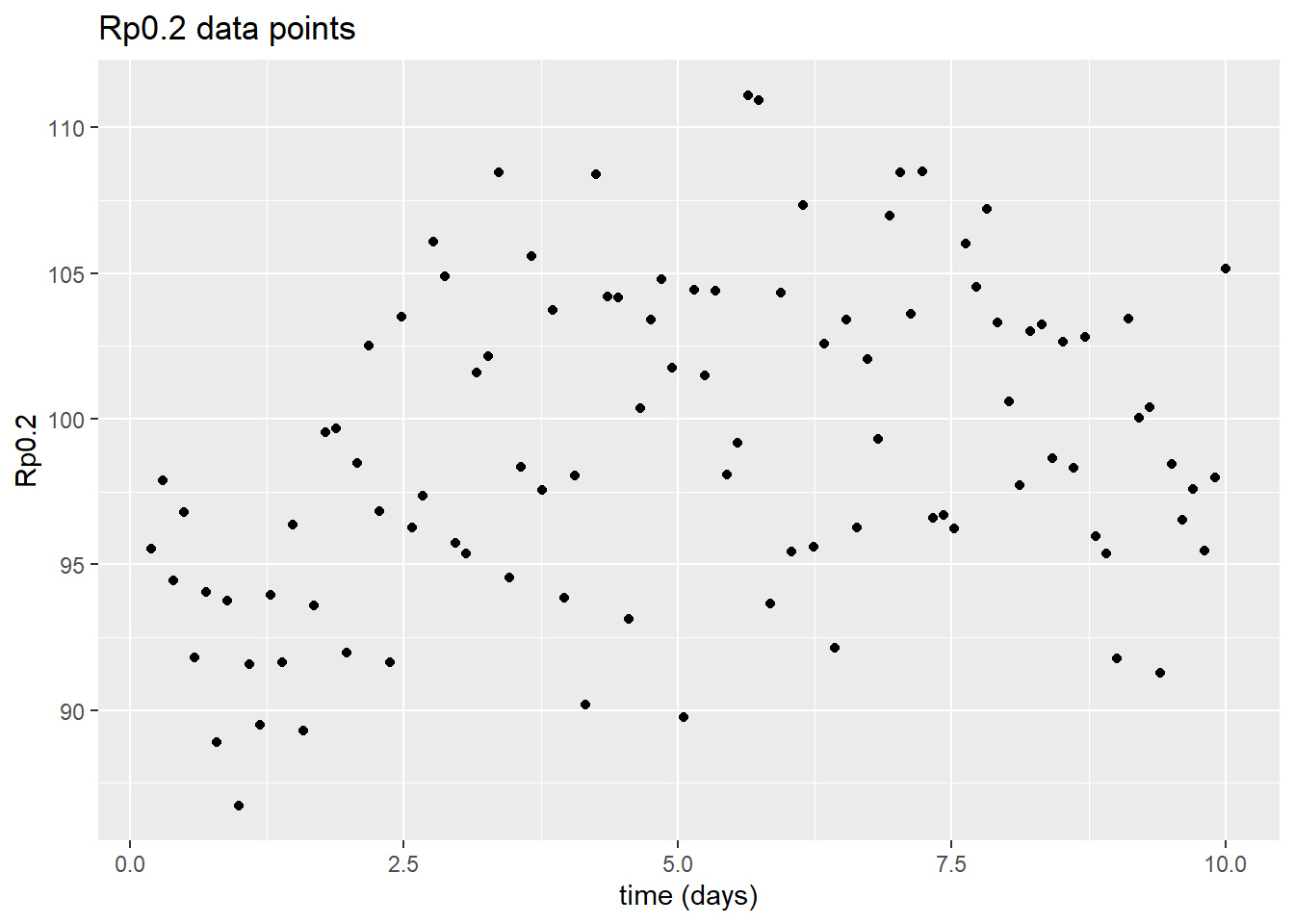
Données simulées pour l'étude de résistance mécanique

Solution bayésienne avec intervalle de confiance à 95%
Result Interpretation
- Dark line : Median curve estimate
- Dark red zone : 50% credibility interval
- Light pink zone : 95% credibility interval
- Black points : Simulated data used for inference
2. Two alloys [january 2024]
The natural extension involves handling data from two different alloys with distinct aging behaviors.
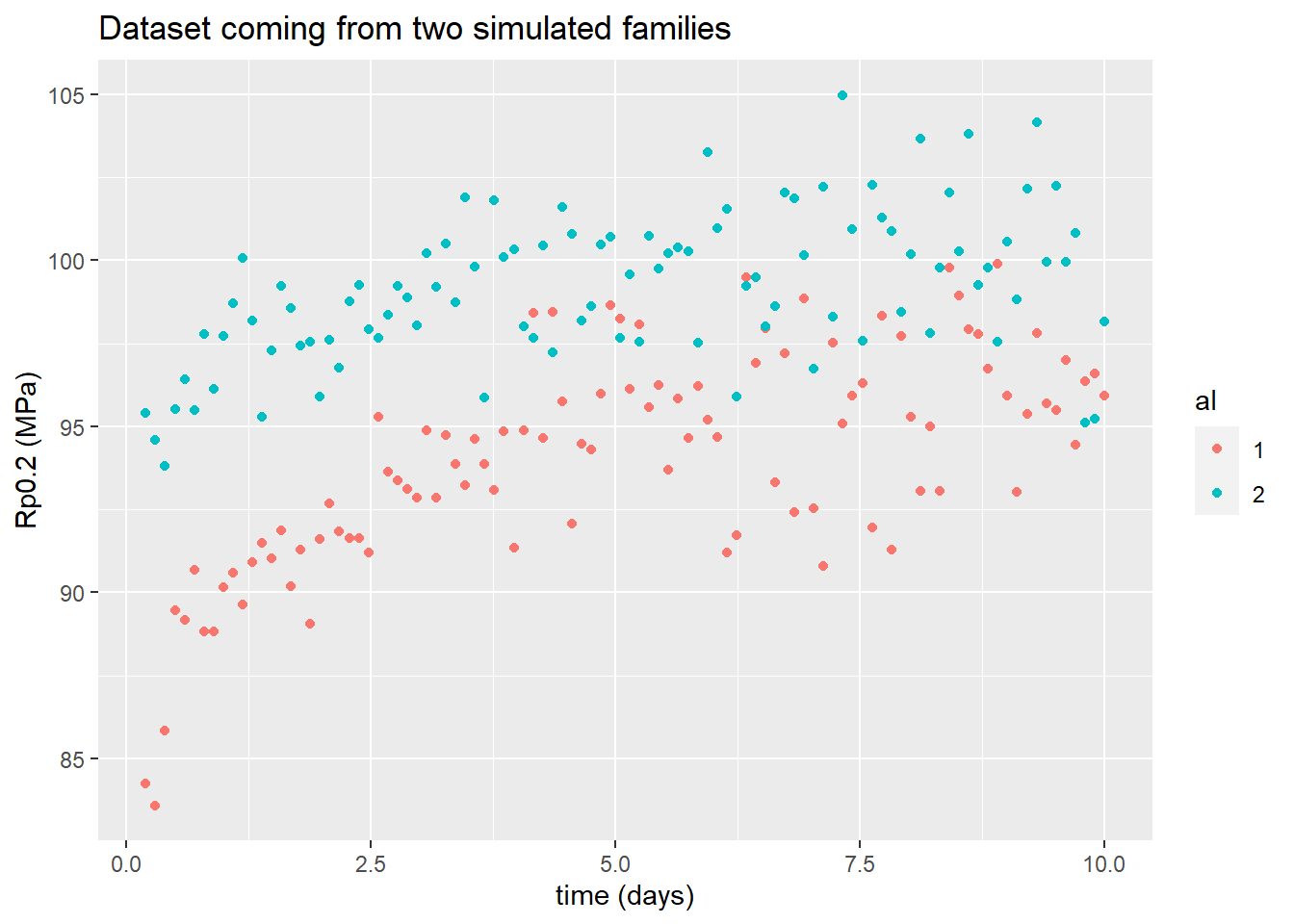
Données expérimentales pour deux types d'alliages
Hierarchical Modeling
For this situation, we use a Bayesian hierarchical model:
where parameters a and b are conditioned by the alloy group.
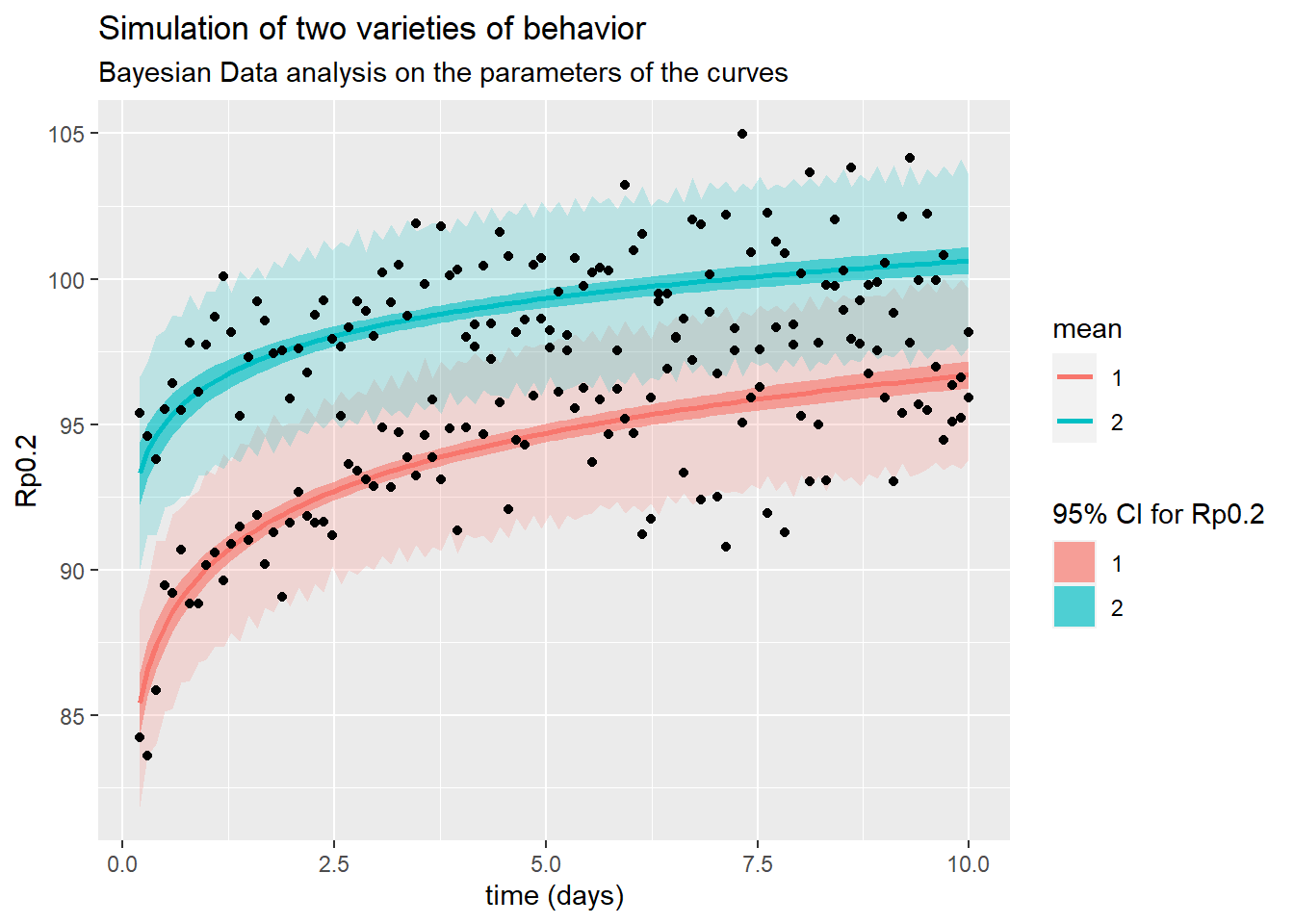
Solutions conditionnées par type d'alliage
Technical Details
- Priors : Weakly informative normal distributions
- MCMC chains : 4 chains of 4000 iterations
- Convergence : R̂ < 1.01 for all parameters
- Effective samples : > 2000 per parameter
3. Composition dependence [january 2024]
The final step involves explicitly modeling parameter dependence on alloy element concentrations.
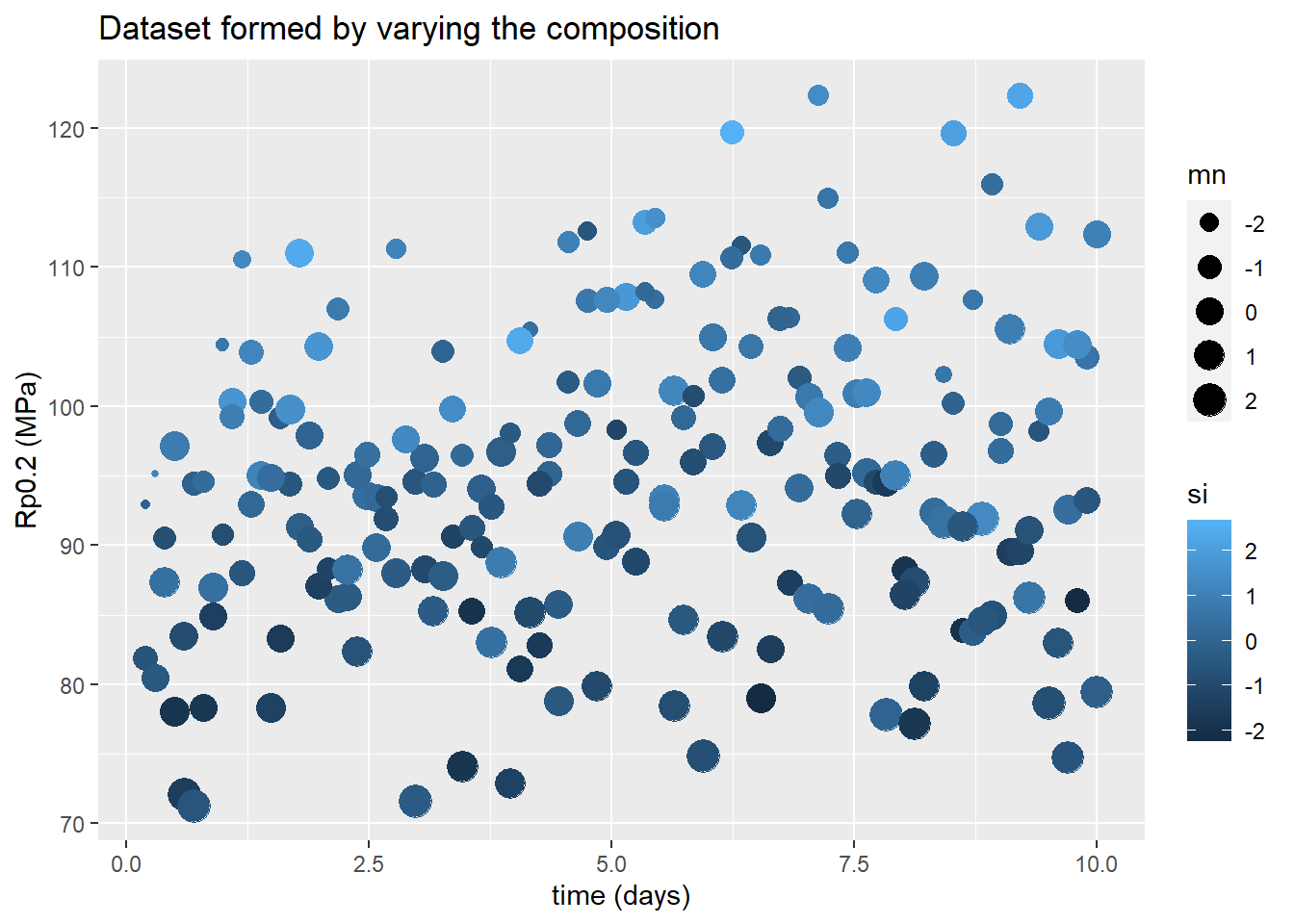
Données avec variations des concentrations en Si et Mn
Complete Model
We define a linear model for parameters:
where [Si] and [Mn] represent silicon and manganese mass concentrations.
Antagonistic Effects
- Silicon (Si) : Strengthens mechanical resistance (αSi > 0)
- Manganese (Mn) : Decreases mechanical resistance (αMn < 0)

Prédictions conditionnées par concentrations
Scenario Analysis
Optimal Scenario
High [Si], low [Mn]
Upper green curve
Unfavorable Scenario
Low [Si], high [Mn]
Lower yellow curve
Compensation
[Si] ≈ [Mn]
Median blue curves
Methodological Conclusion
Bayesian analysis not only estimates parameters with their uncertainties, but also enables conditional predictions for different compositions, and quantifies the causal effect of each alloy element.
This approach provides metallurgical engineers with a powerful decision-making tool for alloy formulation optimization.